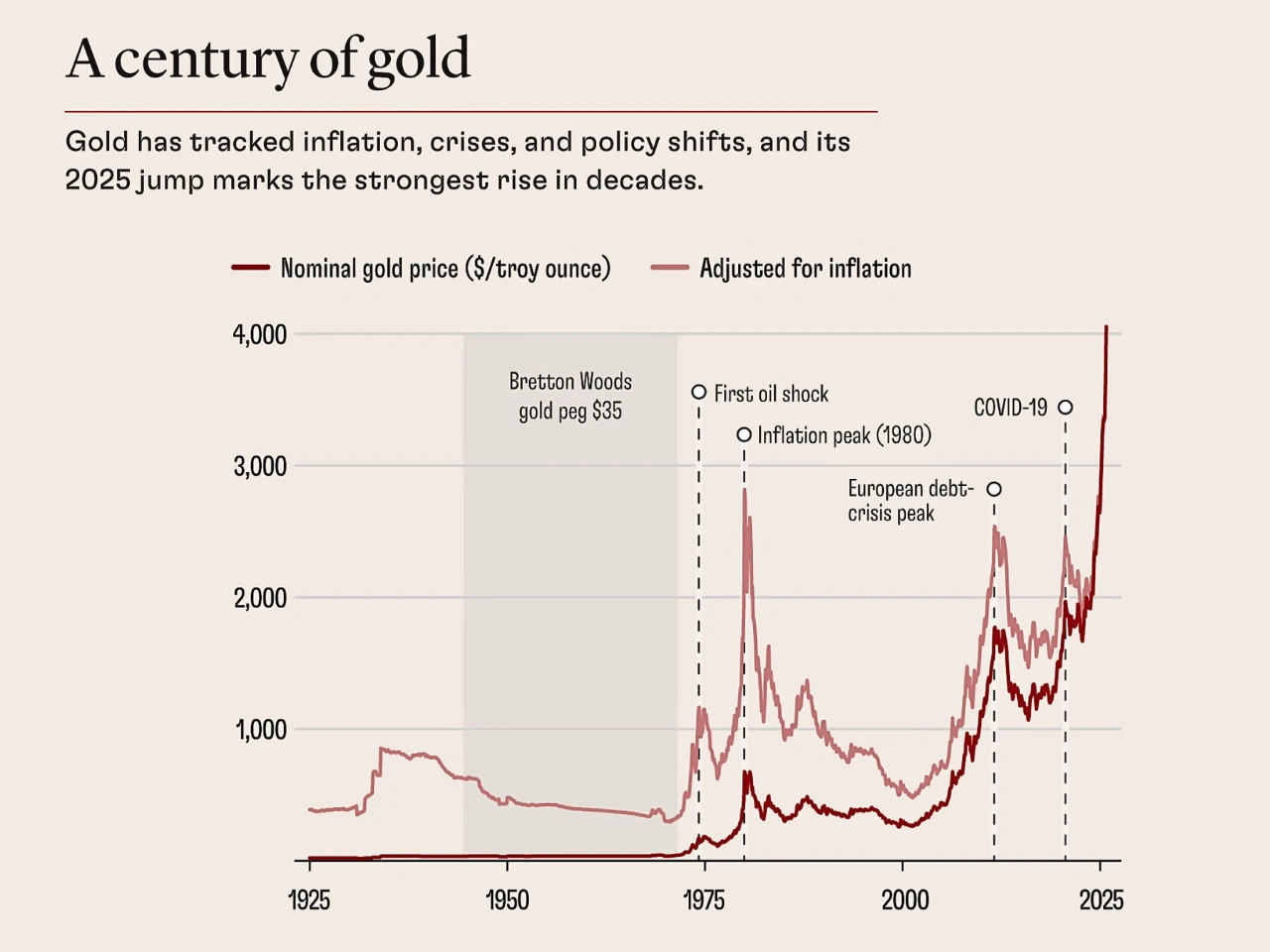
The reason why the oldest store of value in the world is still relevant Gold has held a special place in human society for more than 5,000 years. Empires came and went, currencies came and went, and financial systems have been recreated many times, but gold has lasted. The relevance of the metal in the times of cryptocurrencies, artificial intelligence, and central bank digital currencies might seem confusing. But recent events, such as the phenomenal increase in prices in 2025, prove that the attractiveness of gold is not a phenomenon of the past, but a factor that is being conditioned by timeless economic and psychological laws. This outstanding journey is captured in the chart known as A Century of Gold. The past century has shown the close relation of gold prices to inflation, financial crises, and significant changes in policy. The most notable is the steep increase in 2025, as the highest annual growth in decades, in support of the persistence of gold as a haven of uncertainty.
Sacred Metal into Monetary Anchor-
The first value of gold had nothing to do with markets, but with significance. Gold was linked to God, immortality, and authority as practiced by the ancient cultures of Egypt, Mesopotamia, and Roman cultures. The combination of its physical properties, resistance to corrosion, malleability, and scarcity made it the most suitable material to use in ornamentation and, later, money. The gold coins introduced by the Lydians in the seventh century BCE led to a new era where standardized trade was possible, and the beginnings of monetary systems were established.
By the 19th century, gold had become the foundation of the international financial order. With the classical gold standard, the money could be directly converted into a fixed amount of gold, and this form of discipline kept governments in check, as well as fixed exchange rates. International trade and capital flows promoted by this system have a price: inflexibility. In times of economic stagnation, in particular, the Great Depression, the gold convertibility impeded policy actions and further deflation.
The Bretton Woods and the Death of Convertibility-
The policymakers wanted to settle on a halfway course after World War II. The Bretton Woods system pegged the US dollar against gold at